The unfortunate thing is, though most of the principle actors were on hand, none of the "extras" I've been promised from the tech crew showed up. We are doing a rather involved sequence to portray "The Battle of Five Armies" near the end of "The Hobbit," but because our cast has been so small, we need to create our army of Goblins that attack from the tech crew and anyone else available, as nearly the entire cast is needed to defend the gates of Erebor. This became obvious when our Battle Instructor said, "Okay, now everyone get with a person you will actually be fighting in the play." Most of the attackers were not present. And though, ultimately, Bilbo's friends WIN the battle, the point at which lights go down on the battle, they are losing rather badly. So, what we're going to have to do is make it appear that the army that has been through the most training in stage combat, will lose to an army that at this point has had no training at all...
Monday, April 8, 2013
The Trained Army vs. the Untrained Army
We're now less than a month from SHOWTIME! Last Tuesday we were back for the first rehearsal after Easter break, and we had a special guest, a friend I've known for some time but never before in his capacity as "Battle Coordinator/Combat Instructor/Weapons Expert" (he said, "My title gets better everytime I'm introduced!"). All of Tuesday's rehearsal was devoted to teaching the kids how to LOOK like they were fighting WITHOUT hurting each other. My own path to the stage was along the lines of learning skits and stand-up routines from records, and I'm still far more comfortable with any kind of acting more focused on vocal ability than on anything physical. The majority of my directing has been small skits involving 3-5 people standing or sitting on folding chairs (and more recently, doing puppet plays). So, I'm not the best at "choreographing" ANYTHING, much less battle sequences, and I was VERY grateful to have this friend on hand to teach this aspect of acting to the kids.
The unfortunate thing is, though most of the principle actors were on hand, none of the "extras" I've been promised from the tech crew showed up. We are doing a rather involved sequence to portray "The Battle of Five Armies" near the end of "The Hobbit," but because our cast has been so small, we need to create our army of Goblins that attack from the tech crew and anyone else available, as nearly the entire cast is needed to defend the gates of Erebor. This became obvious when our Battle Instructor said, "Okay, now everyone get with a person you will actually be fighting in the play." Most of the attackers were not present. And though, ultimately, Bilbo's friends WIN the battle, the point at which lights go down on the battle, they are losing rather badly. So, what we're going to have to do is make it appear that the army that has been through the most training in stage combat, will lose to an army that at this point has had no training at all...
Tuesday, March 19, 2013
Character Intensive
Between Volleyball, the "Battle of the Books," and illness, I only had four actors show up for practice... Fortunately two of them were Gandalf and Thorin, and I had intended to work on their scenes together (it would have been nice to have Bilbo, but I'm generally feeling good about how our lead is reading his lines at this point). To shake things up a a bit, I had them read the scene in very different ways--first as if they were all on the verge of tears, then as if they couldn't stop laughing, and finally as if they each wanted to kill the other two. I was impressed with the range they showed, and I think it helped in distinguishing the characters. I found that each character in that particular scene needs to move towards two of those emotions--Bilbo needs to move in the direction of both humor and sadness (or somberness) as he wrestles with the Baggins and Took side of his personality. Thorin needs to move in the direction of both anger and sadness (as he recalls the fall of Erebor and how the dragon killed many of his people). Gandalf needs to move in the direction of both anger (which helped the actor to achieve a sense of authority he'd been lacking) and humor (as he is playing a great joke on both Thorin--passing Bilbo off as a professional burglar, and Bilbo--tricking him into hosting this Unexpected Party and join in the adventure). I'm not sure the ACTORS were able to see the benefit of the exercise, but it helped me to see what they are capable of, and know what I can bring out of them in their performance. A day well-spent!
Monday, March 11, 2013
Goblin faces
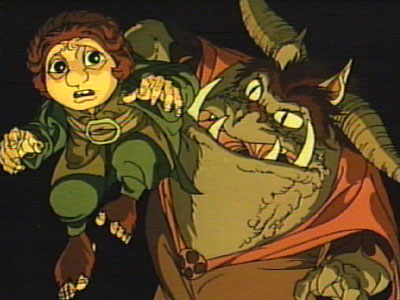
I re-watched the Rankin/Bass animated version of "The Hobbit" last night (on an old faded VHS copy). I'd love to manage some goblin costumes in that style (with the huge gaping mouths), but, given our budget and talent pool, we'll be lucky to find some simple masks and armor for our goblins. More importantly, I'm realizing I have a goblin shortage as we reach the Battle of Five Armies. Earlier, when the goblins grab the dwarfs seeking shelter from the storm, I can actually spare six or seven actors to put on goblin costumes, but at the end of the play, when Erebor is overwhelmed by goblin hordes, I only have TWO actors who aren't supposed to be other characters! So, we're trying to recruit some extras to put on the masks and attack the King under the Mountain. But that gets back to the issue that we need to find or make the masks...
Labels:
Costumes,
Directing,
Goblins,
Masks,
Rankin/Bass,
The Hobbit,
The Hobbit adaptations
Sunday, March 10, 2013

Although my Smaug will largely be covered by piles of treasure, I felt I needed to get some idea of the overall size and shape he should be. Since he is often referred to by Tolkien as a "worm," it seemed he needed to be more serpentine, that is, more long and thin than many dragons I've seen (and certainly not the squat, bug-shaped lizards of "How to Train Your Dragon"). So, here are my early sketches, including the most important "curled up" sleeping pose. He will be reclining through most of the scene, with only his head and neck extending out as he speaks with Bilbo; but at the end of the scene, he needs to rouse himself and "exit" to go take out his wrath on Laketown. And if we can get the one wing to look like he's getting ready to take off, all the better!
Monday, March 4, 2013
I was hoping for a larger dragon, but I had to "scale back"...
I designed a pretty cool-looking 40' Smaug for our production of "The Hobbit," but then realized there was not enough room on stage for him to curl up. So we're down to 30'.
And at rehearsal today, I found out that two of our actors have backed out of the production. One came to me to break the news that he has family commitments out of town the weekend of the show. The other didn't show up and hasn't said anything to me or the producer, but he apparently told all of his cast-mates he couldn't do it.
So, back to the drawing board for THAT as well...
And at rehearsal today, I found out that two of our actors have backed out of the production. One came to me to break the news that he has family commitments out of town the weekend of the show. The other didn't show up and hasn't said anything to me or the producer, but he apparently told all of his cast-mates he couldn't do it.
So, back to the drawing board for THAT as well...
Tuesday, February 26, 2013
The Hobbit is Cast!
Well, it took a good chunk of last night, and makes quite a intricate web of people and parts, but I got the play cast and was able to announce parts at rehearsal today. If anyone is dissatisfied, I haven't heard yet, so I take that as a good sign. Four of the actors have one part each, while the majority have a number of parts to play (with one person with as many as five!). Costume changes will be interesting!
I was glad to be able to add in several non-speaking roles which were not in the script. Though I certainly appreciate Edward Mast's job of shortening the novel to a tolerable length for the stage, he dropped a lot of characters (and races of creatures) that are important to Tolkien's world, and though they won't have much to do, I am glad we will be able to at least visually allude to them in our production. So, though there are no spiders, wolves, eagles or elves (!) mentioned in the script, I had a enough spare actors to work in walk-on roles for each to be represented in our production.
I've been soliciting ideas from a number of friends for the biggest technical challenge of the play--how to portray Smaug the dragon on stage (with little space and budget). This will put my puppet-making skills to the ultimate test!
I was glad to be able to add in several non-speaking roles which were not in the script. Though I certainly appreciate Edward Mast's job of shortening the novel to a tolerable length for the stage, he dropped a lot of characters (and races of creatures) that are important to Tolkien's world, and though they won't have much to do, I am glad we will be able to at least visually allude to them in our production. So, though there are no spiders, wolves, eagles or elves (!) mentioned in the script, I had a enough spare actors to work in walk-on roles for each to be represented in our production.
I've been soliciting ideas from a number of friends for the biggest technical challenge of the play--how to portray Smaug the dragon on stage (with little space and budget). This will put my puppet-making skills to the ultimate test!
Labels:
Casting,
Directing,
drama,
Rhema Christian School,
The Hobbit
Tuesday, February 19, 2013
Let Me Try This Again...
Obviously, I had this idea last year, and failed to follow through with it. The idea is, "Wouldn't it be neat to blog through my experience of directing a play?" Well, yes, it would... assuming I actually did so.
I've been contracted to direct the Spring play at Rhema Christian School again this year, and this time we ARE doing "The Hobbit." Auditions were today, and I was quite pleased by the amount of talent I saw. My biggest concern is that only 13 students showed up. Last year we had 20 kids try out for an original play I wrote which no one had heard of; I was expecting a bit more excitement and a larger turn out when this title was announced. So, somewhat surprised...
This script (adaptation by Edward Mast) has 29 parts, but with doubling (and tripling) of characters, it says it can be pulled off by as few as 10 actors. So, we'll be closer to the original production than I'd expected. More of an ensemble piece. And my problem last year was coming up with enough parts for the actors who showed up!
This should be interesting...
Sunday, February 26, 2012
Good Shepherd of the Outback Heading for the Stage
Tomorrow is try-outs for the Rhema Christian School Spring Play, which I will be directing. I oringinally signed on thinking we were doing The Hobbit, but it turned out that the bulk of the actors, who would be 5th to 8th grade girls, were less than enthusiastic about the idea of putting on beards and acting like dwarves. Next we settled on an adaptation of Rumpelstiltskin, which turned out to have little to do with the title character and mostly be a fantasy in the tradition of Shakespeare's comedies, with no less than EIGHT couples ready to wed at the end. Showing the couples to be in love would have involved some hand-holding or walking arm-in-arm, and that ran afoul of the schools policy on PDA. SO, after much thinking, reading, and negotiating (all while the clock was ticking towards performance dates of April 27 and 28), we finally settled on something we had in hand, that could be adapted easily without violating copyright laws... and we will be doing a full-scale production of The Good Shepherd of the Outback.
I see no real problem telling the story in one night, as opposed to stringing it over five days in serial fashion, and it will be good to give the story a fuller treatment production values that eight weeks of rehearsal and technical development will afford. If the message has come across as well as it has lacking that time and care, I can only imagine it will have more impact if it is presented more professionally.
My only concern is with the fact that every student who tries out is guaranteed a part. And I'm not concerned there in having to work with young actors lacking in talent; my teen drama groups often included actors of limited talent and range, and I've managed to cast them and work with them well. What concerns me is the sheer number of parts that may need to be created to accommodate this. We can double the number of sheep, certainly (we've always alluded to a larger flock than was represented onstage), and there are a few other parts that can be added with no problem. But if we get 30 kids or so showing up tomorrow, it's going to necessitate a major rewrite and create a lot of headaches for blocking!
I see no real problem telling the story in one night, as opposed to stringing it over five days in serial fashion, and it will be good to give the story a fuller treatment production values that eight weeks of rehearsal and technical development will afford. If the message has come across as well as it has lacking that time and care, I can only imagine it will have more impact if it is presented more professionally.
My only concern is with the fact that every student who tries out is guaranteed a part. And I'm not concerned there in having to work with young actors lacking in talent; my teen drama groups often included actors of limited talent and range, and I've managed to cast them and work with them well. What concerns me is the sheer number of parts that may need to be created to accommodate this. We can double the number of sheep, certainly (we've always alluded to a larger flock than was represented onstage), and there are a few other parts that can be added with no problem. But if we get 30 kids or so showing up tomorrow, it's going to necessitate a major rewrite and create a lot of headaches for blocking!
Saturday, August 27, 2011
Good Shepherd Triumphs Again!
Well, Raven S. Wolf's Lamburger machine has once again been destroyed, thanks to "The Good Shepherd of the Outback." The original VBS curriculum and drama was written for COTS in 2008, but we resurrected it this year for our second "VBS in the Village," held at the Rec. Center at Economy/Crestview Village housing projects on the northeast end of Ambridge. Somehow, it seems, no one managed to take photos this year (the one here is me in my wolf costume from 2008), but Barbi Davis managed to capture the climax with her Android and post it to YouTube here: http://www.youtube.com/watch?v=jBUpM59cXqI&feature=share
Although the actors were not as prepared as I would have liked (and due to illness and work schedules we actually had to switch some of the roles from night to night), I think the dramas went well, and the kids were very engaged in the story of the Shepherd, the Hireling, the Lamb who went astray, the Sheepdog, the Predators, the Wooly Bullies and the rest of the flock. I dare say it's one of the best pieces I've written, and once I've had an actual Australian review the dialect and slang, I'm hoping to make it widely available in some fashion. Let me know if any of you are interested!
Saturday, May 28, 2011
Paging Hooto Crunk
Those who know me, or at least those who knew me in my first 30 years, might be surprised I haven't commented on the recent Rapture debacle. The fact is, despite its being all over the mainstream news and fodder for high-profile comedians, I was barely aware of it; oddly enough, it was a friend's Facebook update pointing me to the Doonesbury comic strip that first caused me to try to figure out why the Rapture was such a hot topic all of a sudden.I'd never heard of Harold Camping before May 18th, and didn't find anything compelling in his reasons for stating that the Rapture of Jesus' elect would occur on May 21st, so I basically ignored it. It was a full hour after the 6:00 pm (local time) deadline that it occurred to me to check and make sure I was still around, and I didn't bother calling all my friends to make sure they were still here, either.
Earlier in my life, I might have taken this more seriously.
In fact, as a teenager I was quite convinced that the Rapture would happen at any moment, and there were numerous times when I was excited by seeing a particular cloud formation, hearing what I thought might be a distant trumpet, or when I got a little nervous when someone was supposed to meet me somewhere and they were long-delayed. I especially remember sitting on the church bus, ready to leave for my first youth group retreat on October 6, 1973, when the youth pastor stepped on onboard and announced that all of Israel's neighbors had just launched a war against the beleaguered state. Having spent the summer reading Hal Lindsey's Late Great Planet Earth, I was CERTAIN we would NOT be returning from that weekend!
One can only keep that level of anticipation for so long, I suppose. And I guess I am fortunate that no one in my life ever tried to exploit my beliefs in any way (not that I HAD much of anything in those days to be bilked out of. And unlike Camping's narrow following and precise predictions (all based on some bizarre numerological mathematics and dating of incidents like the Crucifixion), the apocalyptic fever of my youth was widely held by the majority of evangelicals, from Hal Lindsey to Jack Chick (the artist of the poster featured here and numerous comic-book style tracts, many dealing with endtimes scenarios) to Pat Robertson to every youth worker I knew to every Christian singer I'd heard, all the way up to Billy Graham! In fact, it wasn't Lindsey who first brought to my attention the fact that there were a lot of Biblical prophecies still awaiting fulfillment, and that many of them seemed to be coming true IN OUR DAY! It was the Billy Graham film His Land, featuring Cliff Barrows and Cliff Richard.
What strikes me as most interesting in comparing recent events to the events of my youth is the fact that, back then, it seemed the whole Church was tuned into and agreed on most of the details of the pre-millenial Rapture doctrine, and made fun of the unchurched, non-Christians who disbelieved it. I especially remember a very creative and funny Christian comedy album by a group called Isaac Air Freight which had a skeptic named Hooto Crunk give an "Editorial Reply" in which he ridiculed the station for endorsing the Rapture. The joke is, that when he finishes recording his piece, all the Christians at the station have disappeared. The clear consensus within evangelical Christendom was, "We're in the know, we all believe this, and pity the fool who doesn't agree with us."
Last week, it seemed clear that the "facts" of the Rapture doctrine were common knowledge to those inside AND outside the church, and the bulk of evangelicals I know or know of were saying, "We all--Christian and non-Christian--know about this, none of us believe it--at least not in the way it is currently being presented, and pity the fool who DOES!"
What a difference 35 years can make!
Tuesday, May 24, 2011
"Pretty-lookin' People"
My daughter, who is "terrified" by thunder, other loud noises, and many other minor things in nature, has no fear of people. On the one hand, this is rather nice; on the other hand, it makes things difficult for me as a parent. The other day, we started on a walk and remembered we needed to go back up to the apartment for something. There was some activity going on at the banquet hall across from our apartment, and a group of men were standing by the trash cans immediately across from our door. My daughter wanted me to go back upstairs by myself and leave her down on the sidewalk, but I insisted she accompany me inside. This led to a bit of a tantrum and long debate over "What's wrong with PEOPLE!? They're not going to KILL me! And if they try to tie me up, I will just run away!" I never said anything about them killing her or tying her up, and I had to admit that probably they were fine people and would not want to do any of that. But I still did not feel it was particularly safe to leave an 8-year-old girl unattended on the curb where I couldn't see her when strange men were hanging about.I was still wondering where I got MY sense that people were dangerous from, when a friend informed me that yesterday was the anniversary of the ambush of Bonnie and Clyde. Suddenly I was six years old, walking with my father through a portable exhibit which included the "Bonnie and Clyde Death Car," with 160 bullet holes and blood-stained upholstery. My Dad was an auto mechanic and car enthusiast, and the Warren Beatty/Faye Dunaway film had been recently released, so Bonnie and Clyde were all over the pop-culture scene of the time. I knew that the couple were bad people ("the devil's children" in the words of the popular song), but I'm not sure I felt a whole lot better about the posse that had inflicted such a barrage of death, or about the people who made money off the exhibit. Overall, it certainly gave me a negative impression of "PEOPLE." But I wouldn't want to share that with my daughter.
So, how does one instill in one's child a balance of fear and trust of strangers? I'm still working on that one...
P.S. The "Death Car" apparently is still being exhibited in various casinos in Nevada.
Labels:
1960s,
Bonnie and Clyde,
children,
Parenting,
Personal History,
Pop Culture,
Strangers
Tuesday, May 17, 2011
The Colors of Suzy Q
Suzy Q is a puppet I created for our church's children's ministry in "The Village," a local housing project, which we first made contact with when we did a VBS in their Recreation Center last summer. My wife and I were not part of the original team planning to follow up this ministry, but when decisions were made to no longer offer a children's section to the Thursday Night Alpha Classes, we hooked up with this Tuesday night outreach up the hill. Scripts were already planned for a male and female team of puppets, but no one but me had any puppets. And, at that stage, the bulk of my human puppets were store-bought and (consequently) all white-skinned. There are, of course, some whites who live in The Village, but the kids we've had the most interaction with have largely been African-American or bi-racial, so it seemed a good time to create some darker-skinned puppets. I had started working on an African male puppet prior to this decision and assignment, who debuted as Pharaoh's charioteer in a Sunday School play about Moses. "Akil," as he was then called, was smart enough to tell Pharaoh he'd have to drive himself if he wanted to pursue the Israelites into the Red Sea. He took the role of "Sam Wow" in the six-week program we called "Winterfest." But he needed a partner, and so I created a slightly lighter skinned woman with long hair done up with beads, long eyelashes, brilliant pink lips (tinged with purple), dark pink fingernails and zebra-striped glasses. Suzy Q was written as a reporter, and I took that to mean a television reporter, so I went for a strong sense of style. I managed to find a trench coat for her (size 3T--too good to pass up!), but needed a top to go under it and peak through the V-neck. What I found was white, with a plaid pattern including some pink, purple and green. And that was her costume throughout "Winterfest."
When we started up again around Easter with "Springfest" we decided to adapt an existing curriculum, which had our duo traveling around the world exploring God's creation. The first week, they were in Antarctica, for which Suzy got a fur hat (looking like something out of Dr. Zhivago), a white fur trimmed vest and a purple coat. Last week she was back in her trenchcoat, working as an archaeologist in the Egyptian desert, but this week they were in the Amazon Rainforest of Brazil. It occurred to me I had NO IDEA what people in Brazil wore when hiking through the rainforest, and several pages worth of Google Image results got me no closer than when I'd begun. But I headed off to the thrift store anyways, and one of the first things I saw was this bright green floppy sunhat. Next I found a scarf with the pink, purple and green kind of plaid pattern similar to her original top. I finished off the ensemble with a green tank top, covered by a blouse/jacket with a similar pattern to the scarf, but with pink being more dominant. I still have no idea what most people would wear on a trip up the Amazon, but I know what Suzy Q would wear.
Now, if I could just apply this new-found fashion sense to what to buy for my wife and daughter...
Tuesday, September 28, 2010
Teach Me to Dance
"Teach me to dance to the beat of your heart
Teach me to move to the power of your Spirit
Teach me walk in the light of your presence
Teach me to dance to the beat of your heart"
"Teach Me to Dance" lyrics by Greg Holland
As we did with Alpha last Spring, Beth and I started off our first !TNT! meeting this semester playing this song from a CD called Devotion by the African Children's Choir. We encourage the children to get up and dance and "get the wiggles out" before we get started. In the past, we have had few takers (other than our own daughter). This week, though, we had one new boy from our church and two new girls who first made connection with us via our VBS up in the Village.
I am no dancer, and in fact I grew up in one of those kinds of churches that viewed most dancing as sinful (unless, maybe, it was the Virginia Reel). It isn't easy for me to get up and move to music if anybody is watching me, even if they are young kids. But I needed to set the example, so I was up and moving to the music, and eventually they all got into it, sometimes even dancing with me.
I tend to approach life in a rather academic way, and I often confuse things of the spirit with things of the mind. I tend to think of discipleship as something that is taught, like algebra or history, but it is really a lot more like learning to dance, watching the Teacher and trying to move like he does.
Labels:
"Teach Me to Dance",
Children's Ministry,
Dance,
Discipleship,
TNT
Tuesday, September 21, 2010
Busy, Busy, Busy!
"Busy, busy, busy, busy as a bee/Martha was so busy, she did not have time to breathe."
That's the refrain from Bob Hartman's story of Martha and Mary, which we read at family devotions the other night. It is also very much in my mind as I work to finish sewing a Bee puppet for our !TNT! (Thursday Nights Together) meeting, beginning this week. As with last spring, Beth and I will be teaching the younger children (K-4th grade), and this semester our topic is the Beatitudes. Last Spring, we were doing the Alpha curriculum, which seeks to answer various questions about basic Christianity, and our mascot/recurring character was a young owl named Alphie, who had a lot of questions and wanted to be wise when he grew up ("Who ever heard of a DUMB old owl?"). So, as I thought of the Beatitudes, the pun "Bee-Attitudes" came to mind (though obviously I'm not the only one to think of it, as a casual search on Google will show!). Though, the more I thought of it, the more it seemed to me the stereotypical attitudes associated with bees (always being busy being the chief one), the more I saw that the "Bee-Attitudes" might differ markedly from the Beatitudes that Jesus taught. A "Busy Bee" might even be upset that Jesus "sat down" to teach!
And so, I created Benny as a rather high-strung (not "stung") honey bee. He is eager to help teach the kids, and assumes he knows what the Beatitudes are (because they sound like Bee Attitudes), but in fact he is in need of some gentle correcting from my wife, who works as the main teacher for each series. For the voice, all I had to do was speak rather excitedly and change all my s's to zz's, and stretch out any long e's.
For his first outing, Benny had only four legs, no wings, and no stinger, but I'm hoping to have him finished by next week.
That's the refrain from Bob Hartman's story of Martha and Mary, which we read at family devotions the other night. It is also very much in my mind as I work to finish sewing a Bee puppet for our !TNT! (Thursday Nights Together) meeting, beginning this week. As with last spring, Beth and I will be teaching the younger children (K-4th grade), and this semester our topic is the Beatitudes. Last Spring, we were doing the Alpha curriculum, which seeks to answer various questions about basic Christianity, and our mascot/recurring character was a young owl named Alphie, who had a lot of questions and wanted to be wise when he grew up ("Who ever heard of a DUMB old owl?"). So, as I thought of the Beatitudes, the pun "Bee-Attitudes" came to mind (though obviously I'm not the only one to think of it, as a casual search on Google will show!). Though, the more I thought of it, the more it seemed to me the stereotypical attitudes associated with bees (always being busy being the chief one), the more I saw that the "Bee-Attitudes" might differ markedly from the Beatitudes that Jesus taught. A "Busy Bee" might even be upset that Jesus "sat down" to teach!
And so, I created Benny as a rather high-strung (not "stung") honey bee. He is eager to help teach the kids, and assumes he knows what the Beatitudes are (because they sound like Bee Attitudes), but in fact he is in need of some gentle correcting from my wife, who works as the main teacher for each series. For the voice, all I had to do was speak rather excitedly and change all my s's to zz's, and stretch out any long e's.
For his first outing, Benny had only four legs, no wings, and no stinger, but I'm hoping to have him finished by next week.
Tuesday, September 7, 2010
Pirates, Saints, and Bees--Oh, My!
After a long stretch of little creative energy, I suddenly find I'm SWIMMING in writing projects! Some are work related, and others are "just for fun" (or profit, if any of them would sell!)
First off, we re-staged our "Pirates in Paradise" VBS program (originally written and performed in 2007) this summer. Because we opted to do the VBS in the evening, and wanted to keep the final night as the presentation to the parents, I had to rewrite it to fit the storyline into four episodes rather than five. Since I was rewriting, and had a couple other actors who wanted to be pirates, I created a few new roles, and I was able to polish parts (and write some parts which had originally been ad-libbed). At any rate, that inspired me to think more about these characters and about the sequel I had proposed writing for last year's VBS (which we pulled the plug on due to insufficient volunteers). The original Pirates VBS deals with teaching the pirates to claim the Royal Pardon, forsake piracy, and store up treasure in heaven; at the conclusion most of the pirates do so, rechristening their ship "The Heavenly Pearl" and setting off to tell others the good news. So, the sequel focuses on the converted pirates' missionary journeys (and the Pirate Captain's attempts to somehow get back his ship). I spent a good part of vacation jotting down notes and working out the plot and I feel like I'm ready to write it now.
Of course, that is far from pressing. On September 23rd, we will be re-launching !TNT! (Thursday Nights Together), a family based program for which my wife and I will be leading the youngest component (K-4th grade) through a study of the Beatitudes. Last Spring we did a child's version of Alpha, and the featured character (puppet) was a young owl named Alphie who had a LOT of questions he wanted answered. This session, since we're doing the Beatitudes, I thought the featured character should be a Bee. Though as I'm thinking about it, the "Bee Attitudes" are probably very different from the Beatitudes. The Bee character that is developing is someone who stays very busy, always working to make more honey, and not too good about sharing it. So he will prove to be more of a foil to my wife, who will have to correct him and teach him to be more humble and relaxed about things.
At the same time, we are revamping our "Church School" to become "Children's Worship," following more closely the pattern of what is going on in the "adult" service upstairs. The storytelling time (serving as the sermon) will be surveying what our Bishop has recommended as the 100 Essential Bible passages, and we are hoping to do so creatively, with Godly-Play style interaction and some puppet shows. I have offered to write a puppet show for the Joseph story. We also hope to have the children present a puppet show for the adults on All Saints Day (observed). Speaking with our rector this morning, he would like us to focus on the heavenly worship as described in Revelation... which I did a couple years ago for the closing semester of KidzLife. So I'll be dusting off (or adapting) some of my "Visions of Patmos" material, and figuring out how to do that with little children as the puppeteers.
What I LEAST need to work on (and am having the most fun with) is actually a writing project of my wife's. She has been kicking around an idea for a "mid-grade mystery series" (think Nancy Drew, or better, Trixie Belden), set in 1976. I started helping her with researching (and remembering) the time period, and I've gotten very into it.
Then there is the adult play dealing with Simon the Pharisee/Leper and the Woman with the Alabaster Flask who anointed Jesus at Simon's feast. I began that last spring, and haven't done much with it lately, but it feels important and like something I really need to do.
The question is, WHEN?
First off, we re-staged our "Pirates in Paradise" VBS program (originally written and performed in 2007) this summer. Because we opted to do the VBS in the evening, and wanted to keep the final night as the presentation to the parents, I had to rewrite it to fit the storyline into four episodes rather than five. Since I was rewriting, and had a couple other actors who wanted to be pirates, I created a few new roles, and I was able to polish parts (and write some parts which had originally been ad-libbed). At any rate, that inspired me to think more about these characters and about the sequel I had proposed writing for last year's VBS (which we pulled the plug on due to insufficient volunteers). The original Pirates VBS deals with teaching the pirates to claim the Royal Pardon, forsake piracy, and store up treasure in heaven; at the conclusion most of the pirates do so, rechristening their ship "The Heavenly Pearl" and setting off to tell others the good news. So, the sequel focuses on the converted pirates' missionary journeys (and the Pirate Captain's attempts to somehow get back his ship). I spent a good part of vacation jotting down notes and working out the plot and I feel like I'm ready to write it now.
Of course, that is far from pressing. On September 23rd, we will be re-launching !TNT! (Thursday Nights Together), a family based program for which my wife and I will be leading the youngest component (K-4th grade) through a study of the Beatitudes. Last Spring we did a child's version of Alpha, and the featured character (puppet) was a young owl named Alphie who had a LOT of questions he wanted answered. This session, since we're doing the Beatitudes, I thought the featured character should be a Bee. Though as I'm thinking about it, the "Bee Attitudes" are probably very different from the Beatitudes. The Bee character that is developing is someone who stays very busy, always working to make more honey, and not too good about sharing it. So he will prove to be more of a foil to my wife, who will have to correct him and teach him to be more humble and relaxed about things.
At the same time, we are revamping our "Church School" to become "Children's Worship," following more closely the pattern of what is going on in the "adult" service upstairs. The storytelling time (serving as the sermon) will be surveying what our Bishop has recommended as the 100 Essential Bible passages, and we are hoping to do so creatively, with Godly-Play style interaction and some puppet shows. I have offered to write a puppet show for the Joseph story. We also hope to have the children present a puppet show for the adults on All Saints Day (observed). Speaking with our rector this morning, he would like us to focus on the heavenly worship as described in Revelation... which I did a couple years ago for the closing semester of KidzLife. So I'll be dusting off (or adapting) some of my "Visions of Patmos" material, and figuring out how to do that with little children as the puppeteers.
What I LEAST need to work on (and am having the most fun with) is actually a writing project of my wife's. She has been kicking around an idea for a "mid-grade mystery series" (think Nancy Drew, or better, Trixie Belden), set in 1976. I started helping her with researching (and remembering) the time period, and I've gotten very into it.
Then there is the adult play dealing with Simon the Pharisee/Leper and the Woman with the Alabaster Flask who anointed Jesus at Simon's feast. I began that last spring, and haven't done much with it lately, but it feels important and like something I really need to do.
The question is, WHEN?
Wednesday, August 18, 2010
Camels and Pigs
In addition to the Pirate storyline in VBS, we had a "Story time" built into the curriculum. When we did it in 2007, this was one of several stations that the children would rotate through, and I designed it as more of an interactive teaching station. This year, because of space constrictions, we were not able to break into groups and had to do everything as a big group in the same space, which inhibited the "interactive" piece of it. We decided to use a version of "Godly Play" to tell the story three of the nights, and do puppet shows the other two.
The two stories we decided should be done with puppets were The Rich Young Ruler and The Prodigal Son. Trying to think in terms of how best to tell these stories using puppets, I keyed in on the animals in the stories; in the case of the Rich Young Ruler, I decided to tell the story from the perspective of a camel, as if ANYONE knows how impossible it is to get a camel through the eye of the needle, it would be a CAMEL. With the Prodigal, the obvious animal choice was to tell the story from the point of view of the pigs that the Prodigal was hired to feed at his lowest point.
Having neither a camel nor pig puppet, having no budget, and running out of time to make anything from scratch, I ran down to my favorite thrift store (Red White and Blue) in hopes of finding some second-hand stuffed animals I could use. The pigs were easy to find, but, as you might guess, there were no camels to be seen. I ended up piecing together the head and neck of a snake, the mouth of a donkey, and the body of a leopard (all pinned together and covered with a tan cloth) to create the camel.
Driving home from the thrift store, I was given the voice and character of the camel, as well as the name, "Canticle, the Cantankerous Camel." It was a low voice with a southern twang (something in the neighborhood of Foghorn Leghorn, without the constant repetition), and as a beast of burden, he had a lot of complaints about people with "lots of STUFF!" The voice and character came so strong, I ended up writing the piece as a monologue, with Canticle talking about Camels' place in New Testament society and in Jesus' teaching, and then recounting the story of the "this Rich Kid with all this STUFF which BLINDED him to th' fact that he GOD ALMIGHTY was standin' there RIGHT in FRONT'v'HIM! WHADDIDHE DO? He TURNED AROUND and walked AWAY! 'TseNUFF to makye wanna SPIT!!"
I couldn't tell how well the story went over on the other side of the puppet booth--there was a lot of chatter in the room at the time--but individual kids who saw the puppet before and after the performance really seemed to respond well to him.
The pigs' story failed to materialize, but I think that was just as well. I decided that needed to be more interactive, so I used a version of the Prodigal by Bob Hartman, which involved the audience in saying certain rhyming words and making certain gestures throughout the story. We did use puppets to act out the story, but that was more of a backdrop to the Hartman interactive storytelling piece.
The two stories we decided should be done with puppets were The Rich Young Ruler and The Prodigal Son. Trying to think in terms of how best to tell these stories using puppets, I keyed in on the animals in the stories; in the case of the Rich Young Ruler, I decided to tell the story from the perspective of a camel, as if ANYONE knows how impossible it is to get a camel through the eye of the needle, it would be a CAMEL. With the Prodigal, the obvious animal choice was to tell the story from the point of view of the pigs that the Prodigal was hired to feed at his lowest point.
Having neither a camel nor pig puppet, having no budget, and running out of time to make anything from scratch, I ran down to my favorite thrift store (Red White and Blue) in hopes of finding some second-hand stuffed animals I could use. The pigs were easy to find, but, as you might guess, there were no camels to be seen. I ended up piecing together the head and neck of a snake, the mouth of a donkey, and the body of a leopard (all pinned together and covered with a tan cloth) to create the camel.
Driving home from the thrift store, I was given the voice and character of the camel, as well as the name, "Canticle, the Cantankerous Camel." It was a low voice with a southern twang (something in the neighborhood of Foghorn Leghorn, without the constant repetition), and as a beast of burden, he had a lot of complaints about people with "lots of STUFF!" The voice and character came so strong, I ended up writing the piece as a monologue, with Canticle talking about Camels' place in New Testament society and in Jesus' teaching, and then recounting the story of the "this Rich Kid with all this STUFF which BLINDED him to th' fact that he GOD ALMIGHTY was standin' there RIGHT in FRONT'v'HIM! WHADDIDHE DO? He TURNED AROUND and walked AWAY! 'TseNUFF to makye wanna SPIT!!"
I couldn't tell how well the story went over on the other side of the puppet booth--there was a lot of chatter in the room at the time--but individual kids who saw the puppet before and after the performance really seemed to respond well to him.
The pigs' story failed to materialize, but I think that was just as well. I decided that needed to be more interactive, so I used a version of the Prodigal by Bob Hartman, which involved the audience in saying certain rhyming words and making certain gestures throughout the story. We did use puppets to act out the story, but that was more of a backdrop to the Hartman interactive storytelling piece.
Sunday, August 15, 2010
The Heavenly Pearl Sails Off Again!
We just concluded the 2010 version of "Pirates in Paradise" VBS. The curriculum and original skits were written and first staged here at COTS in 2007, followed by "The Good Shepherd of the Outback" in 2008. Last year, we had planned to create a sequel to the "Pirates," but that didn't come off due to a shortage of volunteers in the morning. This year we made two strategic decisions; the first was to offer VBS in the evening (so as to get more volunteers), and the second was to stage the VBS in the Recreation Center of a couple housing projects on the north end of town. Although my personal preference continues to be for a morning VBS in our church building, it is hard to argue with the results--we had 20+ volunteers each night and a total of 60 kids who participated in the VBS this summer. What exactly this leads to remains to be seen, but I am hoping to see our church commit to some sort of follow-up, with the possibility of eventually planting a church in that neighborhood.
The biggest creative challenge in revising the script this year was in shortening the storyline from five to four days. Previously, in doing a morning VBS, we had the closing program for the parents the evening of the final day, and it was felt by the team that we needed to the keep the final evening as a summary of the story for the parents' sake, wrapping up the actual storyline on Thursday night. In retrospect, I think I would argue for returning to the five-day format, as there were very few parents who actually attended, and I think it best to send the kids off with an exciting conclusion to the story, rather than a recap in which nothing dramatic happens.
I also added two more pirates, because we had two individuals who were inexperienced actors but well-know to the kids in the village (or at least, better known than the rest of our team). It seemed worthwhile to get them up front for the dramas, but I will be dropping back to my original three pirates in the future (the Captain and two crew members. Amongst other things, the stage got very crowded with five pirates (ESPECIALLY in the cramped space of the Rec. Center), and there was no good way to work the additional characters into the climax of the show.
Personally, the biggest challenge was for me to assume the role of Milligan, the island host to the visiting children and Pirates. This character was originally written for a friend named Travis, who is extremely gifted as an actor, a teacher, and someone who has a natural gift of rapport with children. Travis also has a wonderfully peaceful demeanor, which is required for this character--he does not allow the pirates to ruffle or rile him up in any way. My own approach to acting is generally to throw myself into a character, generally very different from myself, and it helps if I can channel my own nervousness about being onstage into a nervous or angry character (which is why I originally cast myself as the Pirate Captain, Harry DuPillage). Breaking down the "fourth wall" to relate to the audience, remaining relaxed and trying to calm others, all while wearing shorts and beach shoes (which I would NEVER do offstage, except on the beach!) was QUITE a challenge to me as an actor. I think I succeeded, overall...
If nothing else, we certainly hammered the memory verses into the kids. A portion of each skit involves Milligan teaching the verse of the day to the the children and his pet parrot, Paolo. But Allie, who acted as M.C., would review the verse before the skit, and Pam, who led the music, would have the kids all SING the verses after the skit. Not that any of that was a bad idea (I was especially appreciative of the fact that Pam WROTE some original music to put to some of the verses), but these kids should CERTAINLY know by now that they should store up "treasure in heaven" rather than "treasure on earth, where moth and rust destroy and where thieves"--or Pirates!--"can break in and steal."
The story ends with the majority of the pirates abandoning piracy, claiming the King's Royal Pardon, and voting off the Captain and any others who want to remain pirates, rechristening their ship from "The Bloody Gem" to "The Heavenly Pearl" and sailing off as missionaries to spread the news of the Royal Pardon to pirates and other sinners they may encounter. Which prepares us for "The Continuing Adventures of the Heavenly Pearl" and a missions-themed VBS I have yet to write!
The biggest creative challenge in revising the script this year was in shortening the storyline from five to four days. Previously, in doing a morning VBS, we had the closing program for the parents the evening of the final day, and it was felt by the team that we needed to the keep the final evening as a summary of the story for the parents' sake, wrapping up the actual storyline on Thursday night. In retrospect, I think I would argue for returning to the five-day format, as there were very few parents who actually attended, and I think it best to send the kids off with an exciting conclusion to the story, rather than a recap in which nothing dramatic happens.
I also added two more pirates, because we had two individuals who were inexperienced actors but well-know to the kids in the village (or at least, better known than the rest of our team). It seemed worthwhile to get them up front for the dramas, but I will be dropping back to my original three pirates in the future (the Captain and two crew members. Amongst other things, the stage got very crowded with five pirates (ESPECIALLY in the cramped space of the Rec. Center), and there was no good way to work the additional characters into the climax of the show.
Personally, the biggest challenge was for me to assume the role of Milligan, the island host to the visiting children and Pirates. This character was originally written for a friend named Travis, who is extremely gifted as an actor, a teacher, and someone who has a natural gift of rapport with children. Travis also has a wonderfully peaceful demeanor, which is required for this character--he does not allow the pirates to ruffle or rile him up in any way. My own approach to acting is generally to throw myself into a character, generally very different from myself, and it helps if I can channel my own nervousness about being onstage into a nervous or angry character (which is why I originally cast myself as the Pirate Captain, Harry DuPillage). Breaking down the "fourth wall" to relate to the audience, remaining relaxed and trying to calm others, all while wearing shorts and beach shoes (which I would NEVER do offstage, except on the beach!) was QUITE a challenge to me as an actor. I think I succeeded, overall...
If nothing else, we certainly hammered the memory verses into the kids. A portion of each skit involves Milligan teaching the verse of the day to the the children and his pet parrot, Paolo. But Allie, who acted as M.C., would review the verse before the skit, and Pam, who led the music, would have the kids all SING the verses after the skit. Not that any of that was a bad idea (I was especially appreciative of the fact that Pam WROTE some original music to put to some of the verses), but these kids should CERTAINLY know by now that they should store up "treasure in heaven" rather than "treasure on earth, where moth and rust destroy and where thieves"--or Pirates!--"can break in and steal."
The story ends with the majority of the pirates abandoning piracy, claiming the King's Royal Pardon, and voting off the Captain and any others who want to remain pirates, rechristening their ship from "The Bloody Gem" to "The Heavenly Pearl" and sailing off as missionaries to spread the news of the Royal Pardon to pirates and other sinners they may encounter. Which prepares us for "The Continuing Adventures of the Heavenly Pearl" and a missions-themed VBS I have yet to write!
Monday, May 31, 2010
"We Really Are the Grass!"
In my job at SAMS (South American Missionary Society->Society of Anglican Missionaries and Senders), each month one of us on staff writes a letter which goes out to our donors along with their receipts, sharing news, stories, or reflections on mission. May was my month, and I was a bit more personal in my reflections than is usual. At any rate, it seemed suitable to post my thoughts here, so here it is:
===========
May 2010
Dear Partners in Ministry,
“All flesh is like grass and all its glory like the flower of grass. The grass withers, and the flower falls,but the word of the Lord remains forever.” (1 Peter 1:24-25)
Entering my 50th year this month, I was greeted by an old friend (a year younger than me), who commented, “We really are the grass!” Though 50 may be in the rear-view mirror for many of you, those of us approaching it still see it as a landmark of some significance, and wonder at how fast it is coming (especially those of us who were convinced we’d be raptured some 30 years ago)! This and other more serious events have caused me to think a lot recently on the transience of human life and accomplishments.
My actual birthday coincided with a visit to Virginia to the house my grandparents built 75 years ago. My aunt had rented out the place since her parents passed away, but facing financial hardships herself, had finally had to sell it. This was the last time anyone in our family would be able to gather under that roof or enjoy the spacious yard which had been the scene of so many cook-outs and croquet games. It was the final tract of a 17-acre “Crumbaugh Village” on the edge of Falls Church, and though it was no Monticello, it had stood all these years as a monument to my own connection to “the Greatest Generation.” Knowing that the new owner will likely demolish the building or renovate it beyond recognition made its passing from the family even more sad.
The emotional impact of that, however, was blunted by the fact that the same week my father-in-law had been hospitalized in Richmond with a failing heart. This came as a shock to us all, as for the past 20 years he has kept to a vegetarian diet, walked several miles a day, and done all he could possibly do to avoid just such a fate. God’s love and grace was evident in many ways while he was in the hospital (including the fact that 26 family members were able to visit, some driving from as far away as Montana), and he is home now receiving loving care from his wife (who trained as a nurse years ago). Despite the fact he is once again amazing everyone with how healthy he appears, the doctor’s long-term prognosis is not good.
The incarnation of Christ, and the way he lived his life (“Look at him! A glutton and a drunkard, a friend of tax collectors and sinners!”) teach us that this life is to be enjoyed and lived to the full. But Jesus never lost sight of his mission in this world, and the eternal consequences of what takes place here on this earth. We, too—as individuals and as a society—have a mission to fulfill in this life. While we don’t want to be “too heavenly minded to be any earthly good,” we need to keep focused so that when the Master returns (whether at the last trump or in a personal invitation to Glory) he will find us diligently doing the work he has given us to do. As the plaque on my neighbor’s kitchen reads: “Only one life, ‘twill soon be passed. Only what’s done for Christ will last.”
Blessings,
Dana Priest
Donor Relations Associate
===========
May 2010
Dear Partners in Ministry,
“All flesh is like grass and all its glory like the flower of grass. The grass withers, and the flower falls,but the word of the Lord remains forever.” (1 Peter 1:24-25)
Entering my 50th year this month, I was greeted by an old friend (a year younger than me), who commented, “We really are the grass!” Though 50 may be in the rear-view mirror for many of you, those of us approaching it still see it as a landmark of some significance, and wonder at how fast it is coming (especially those of us who were convinced we’d be raptured some 30 years ago)! This and other more serious events have caused me to think a lot recently on the transience of human life and accomplishments.
My actual birthday coincided with a visit to Virginia to the house my grandparents built 75 years ago. My aunt had rented out the place since her parents passed away, but facing financial hardships herself, had finally had to sell it. This was the last time anyone in our family would be able to gather under that roof or enjoy the spacious yard which had been the scene of so many cook-outs and croquet games. It was the final tract of a 17-acre “Crumbaugh Village” on the edge of Falls Church, and though it was no Monticello, it had stood all these years as a monument to my own connection to “the Greatest Generation.” Knowing that the new owner will likely demolish the building or renovate it beyond recognition made its passing from the family even more sad.
The emotional impact of that, however, was blunted by the fact that the same week my father-in-law had been hospitalized in Richmond with a failing heart. This came as a shock to us all, as for the past 20 years he has kept to a vegetarian diet, walked several miles a day, and done all he could possibly do to avoid just such a fate. God’s love and grace was evident in many ways while he was in the hospital (including the fact that 26 family members were able to visit, some driving from as far away as Montana), and he is home now receiving loving care from his wife (who trained as a nurse years ago). Despite the fact he is once again amazing everyone with how healthy he appears, the doctor’s long-term prognosis is not good.
The incarnation of Christ, and the way he lived his life (“Look at him! A glutton and a drunkard, a friend of tax collectors and sinners!”) teach us that this life is to be enjoyed and lived to the full. But Jesus never lost sight of his mission in this world, and the eternal consequences of what takes place here on this earth. We, too—as individuals and as a society—have a mission to fulfill in this life. While we don’t want to be “too heavenly minded to be any earthly good,” we need to keep focused so that when the Master returns (whether at the last trump or in a personal invitation to Glory) he will find us diligently doing the work he has given us to do. As the plaque on my neighbor’s kitchen reads: “Only one life, ‘twill soon be passed. Only what’s done for Christ will last.”
Blessings,
Dana Priest
Donor Relations Associate
Tuesday, April 27, 2010
A Debt We Could Not Pay
Let he without sin cast the first stone if you will.
To say that my bride isn't worth half the blood that I've spilled.
Point your finger and laugh if you choose
to say my beloved is borrowed and used
She is strong enough to stand in my love.
I can hear her say..
"I am weak.
I am poor,
I'm broken, Lord,
but I'm yours.
Hold me Now.
Hold me Now."
--Jennifer Knapp, "Hold Me Now" from Kansas (1997)
I've been thinking a lot this past week about the woman with the alabaster flask and the Pharisee named Simon (and that was even before Miriam's sermon on Sunday!). I ran across the story again in my own reading the previous week, and it has stuck with me. In a brief Google search I found that there are some that link "Simon the Pharisee" with "Simon the Leper" and try to argue that this anointing and the account of an anointing at the end of Jesus' ministry (by Mary of Bethany, in John's version) are the same event, both occurring in the home of someone named Simon. Although I doubt that is the case historically, there is the argument that Jesus said "wherever this gospel is proclaimed in the whole world, what she has done will also be told in memory of her" (Matt. 26:13), and Luke records no other anointing. It is also fascinating for me as a dramatist to think about the various connections that would arise if the two stories were versions of the same event--just the idea of a Pharisee (upholder of the rules of ritual purity) becoming a leper (one of the people most ostracized by such laws) provides a ton of material to wrestle with dramatically in itself! But I digress...
The point which caught my attention at first was the parable that Jesus told Simon about the two debtors. One owed 500 denarii (a days' wage) and the other owed 50, and both debts were forgiven by the moneylender. Jesus asked which would love the person who forgave their debts more, and Simon answered (correctly, according to Jesus) that the one forgiven more would love more. Jesus then made the connection between the "sinful woman" and the debtor who owed the larger sum, and used that to explain her actions (which the Pharisee thought wildly inappropriate). Simon was left to see himself as unable of experiencing a love of that level, because he'd only been forgiven a little.
NOW, the question is, "Is that true?" Did the upright (uptight) Pharisee just not sin enough? Should he have loosened up, lived it up, and become an extravagant sinner so that God could forgive him much more, and consequently he could love God that much more? Does God weigh our sins in the scales like a moneylender? Were the woman's sins REALLY ten times as much as the Pharisee's?
OF COURSE NOT! ALL sin is abominable in God's sight! Jesus died for the sins of the world, but he wouldn't have had to die any less to fully forgive one person's one sin. Death is death and sin is sin. It's ridiculous to attempt to measure either, let alone compare measurements.
So why did Jesus tell this parable? If sins cannot really be measured, then why tell a story in which God is depicted as a moneylender managing debts and parceling out pardons? Probably because that is the only way Simon could think of God. If one wants to be able to distance oneself from other sinners, if one wants to justify himself in God's sight by saying, "I thank thee, O God, that I am not like other people--they sin TEN TIMES more than I do!" then one has to imagine that God is keeping track of these things with at least as much scrutiny as we are.
BUT, if we would realize the seriousness of our own sin--of each and every "small" sin we do--and of what it cost our God to forgive it, then we could ALL love as lavishly as the woman with the alabaster flask.
To say that my bride isn't worth half the blood that I've spilled.
Point your finger and laugh if you choose
to say my beloved is borrowed and used
She is strong enough to stand in my love.
I can hear her say..
"I am weak.
I am poor,
I'm broken, Lord,
but I'm yours.
Hold me Now.
Hold me Now."
--Jennifer Knapp, "Hold Me Now" from Kansas (1997)
I've been thinking a lot this past week about the woman with the alabaster flask and the Pharisee named Simon (and that was even before Miriam's sermon on Sunday!). I ran across the story again in my own reading the previous week, and it has stuck with me. In a brief Google search I found that there are some that link "Simon the Pharisee" with "Simon the Leper" and try to argue that this anointing and the account of an anointing at the end of Jesus' ministry (by Mary of Bethany, in John's version) are the same event, both occurring in the home of someone named Simon. Although I doubt that is the case historically, there is the argument that Jesus said "wherever this gospel is proclaimed in the whole world, what she has done will also be told in memory of her" (Matt. 26:13), and Luke records no other anointing. It is also fascinating for me as a dramatist to think about the various connections that would arise if the two stories were versions of the same event--just the idea of a Pharisee (upholder of the rules of ritual purity) becoming a leper (one of the people most ostracized by such laws) provides a ton of material to wrestle with dramatically in itself! But I digress...
The point which caught my attention at first was the parable that Jesus told Simon about the two debtors. One owed 500 denarii (a days' wage) and the other owed 50, and both debts were forgiven by the moneylender. Jesus asked which would love the person who forgave their debts more, and Simon answered (correctly, according to Jesus) that the one forgiven more would love more. Jesus then made the connection between the "sinful woman" and the debtor who owed the larger sum, and used that to explain her actions (which the Pharisee thought wildly inappropriate). Simon was left to see himself as unable of experiencing a love of that level, because he'd only been forgiven a little.
NOW, the question is, "Is that true?" Did the upright (uptight) Pharisee just not sin enough? Should he have loosened up, lived it up, and become an extravagant sinner so that God could forgive him much more, and consequently he could love God that much more? Does God weigh our sins in the scales like a moneylender? Were the woman's sins REALLY ten times as much as the Pharisee's?
OF COURSE NOT! ALL sin is abominable in God's sight! Jesus died for the sins of the world, but he wouldn't have had to die any less to fully forgive one person's one sin. Death is death and sin is sin. It's ridiculous to attempt to measure either, let alone compare measurements.
So why did Jesus tell this parable? If sins cannot really be measured, then why tell a story in which God is depicted as a moneylender managing debts and parceling out pardons? Probably because that is the only way Simon could think of God. If one wants to be able to distance oneself from other sinners, if one wants to justify himself in God's sight by saying, "I thank thee, O God, that I am not like other people--they sin TEN TIMES more than I do!" then one has to imagine that God is keeping track of these things with at least as much scrutiny as we are.
BUT, if we would realize the seriousness of our own sin--of each and every "small" sin we do--and of what it cost our God to forgive it, then we could ALL love as lavishly as the woman with the alabaster flask.
Saturday, January 2, 2010
Pope Benedict's Christmas Eve Sermon
Christmas Day has come and gone, and the Priest family Christmas (this year celebrated on New Year's Day but always delayed by our travels to visit other family members on the actual holiday) has also come and gone. But while we are still within the 12 Days of Christmas, I wanted to write again (as promised) and comment on the Pope's Christmas sermon.
I dimly recall watching some of the ceremonies when Pope Benedict was installed, and I suppose I heard thim then, but I don't recall being deeply affected by anything he may have said at the time. Then again, it was a service and a ceremony I was unfamiliar with. Christmas is another story, and this was the first time I'd watched the Christmas Eve Midnight Mass with "the new pope." There was also a new commentator--my wife and I joked that US Cardinal John P. Foley, who did the broadcast voiceover for 25 years, always sounded like he was covering a tennis match--and the poor guy had to try to make sense of the "shoving" incident early in the broadcast. Although Pope Benedict chose to do the ceremony two hours earlier, it was still broadcast the usual time, which was too late for my wife this year, so I ended up watching alone (which brought things back to the first times I'd watched it).
I've always enjoyed the international flavor of the service, and the camera work and editing (for someone who grew up watching Billy Graham Crusades as the ultimate experience in religious broadcasting, where all the cameramen could do was pan across the crowd or focus on the stadium flags flapping in the breeze, the Vatican offers a real treat to the eyes!) The Protestant part of me sometimes gets squeamish thinking of the oppulence and wondering how much of the lovely art and architecture of St. Peter's was purchased by misguided people purchasing indulgences, but for the most part I can buy the idea of trying to make a worship space look like heaven by using large dimensions, the best artists and the finest materials available. Heck, wasn't that what Solomon's temple was all about?
But I digress... As inspiring a person as John Paul II was, I don't recall ever being impressed by him as a speaker, or remembering any of his sermons I listened to. And it was the sermon that struck me the most this year.
The main point for me was the contrast Pope Benedict made between the shepherds and the wise men. While the shepherds lived close to Jesus, the wise men had to make "a long and arduous journey" to see and worship the Christ child. This physical distance he likened to spiritual distance; "there are simply and lowly souls who live very close to the Lord," but most of us "live our lives by our philosophies, amid wordly affairs and occupations that totally absorb us and are a great distance from the manger." God has already made a great journey from heaven to be born amongst us, but he still must push and prod most of us to get us to "go over to Bethlehem" and meet him where he has chose to reveal himself.
God wishes for us to come to him, but we must be receptive to his call. The shepherds were "watching"--they were awake and cognizant of the world around them. The wise men came from a pagan culture, and citing Origen (who evidently was citing John the Baptist "out of these stones God can raise children of Abraham" and the author of Psalm 135, who comments that those who make and worship gods of lifeless materials "shall become like them") he says "lacking feeling and reason, they are transformed into stones and wood." But God desires to give us hearts of flesh. He became like us in order to make us become like him. This was the "sign" given to the shepherds--God's humility expressed in the incarnation and seen in a "babe wrapped in swaddling clothes and laying in a manger."
So, we must be alive, we must be awake, and we must be attentive to the presence and calling of God. And repeatedly, Pope Benedict the liturgy (or "Liturgy") as being of prime importance, as "the work of God" and as a time when "the Lord himself is present in our midst," if only we had the grace to see.
Liturgy is something I need to explore this year--for some very practical reasons (at home I am preparing my daughter to begin receiving communion and at the church I am pulling together a Confirmation program for our yout)--but also for my own spiritual well being. So this sermon seemed especially appropriate for me as I kick off the new year.
I dimly recall watching some of the ceremonies when Pope Benedict was installed, and I suppose I heard thim then, but I don't recall being deeply affected by anything he may have said at the time. Then again, it was a service and a ceremony I was unfamiliar with. Christmas is another story, and this was the first time I'd watched the Christmas Eve Midnight Mass with "the new pope." There was also a new commentator--my wife and I joked that US Cardinal John P. Foley, who did the broadcast voiceover for 25 years, always sounded like he was covering a tennis match--and the poor guy had to try to make sense of the "shoving" incident early in the broadcast. Although Pope Benedict chose to do the ceremony two hours earlier, it was still broadcast the usual time, which was too late for my wife this year, so I ended up watching alone (which brought things back to the first times I'd watched it).
I've always enjoyed the international flavor of the service, and the camera work and editing (for someone who grew up watching Billy Graham Crusades as the ultimate experience in religious broadcasting, where all the cameramen could do was pan across the crowd or focus on the stadium flags flapping in the breeze, the Vatican offers a real treat to the eyes!) The Protestant part of me sometimes gets squeamish thinking of the oppulence and wondering how much of the lovely art and architecture of St. Peter's was purchased by misguided people purchasing indulgences, but for the most part I can buy the idea of trying to make a worship space look like heaven by using large dimensions, the best artists and the finest materials available. Heck, wasn't that what Solomon's temple was all about?
But I digress... As inspiring a person as John Paul II was, I don't recall ever being impressed by him as a speaker, or remembering any of his sermons I listened to. And it was the sermon that struck me the most this year.
The main point for me was the contrast Pope Benedict made between the shepherds and the wise men. While the shepherds lived close to Jesus, the wise men had to make "a long and arduous journey" to see and worship the Christ child. This physical distance he likened to spiritual distance; "there are simply and lowly souls who live very close to the Lord," but most of us "live our lives by our philosophies, amid wordly affairs and occupations that totally absorb us and are a great distance from the manger." God has already made a great journey from heaven to be born amongst us, but he still must push and prod most of us to get us to "go over to Bethlehem" and meet him where he has chose to reveal himself.
God wishes for us to come to him, but we must be receptive to his call. The shepherds were "watching"--they were awake and cognizant of the world around them. The wise men came from a pagan culture, and citing Origen (who evidently was citing John the Baptist "out of these stones God can raise children of Abraham" and the author of Psalm 135, who comments that those who make and worship gods of lifeless materials "shall become like them") he says "lacking feeling and reason, they are transformed into stones and wood." But God desires to give us hearts of flesh. He became like us in order to make us become like him. This was the "sign" given to the shepherds--God's humility expressed in the incarnation and seen in a "babe wrapped in swaddling clothes and laying in a manger."
So, we must be alive, we must be awake, and we must be attentive to the presence and calling of God. And repeatedly, Pope Benedict the liturgy (or "Liturgy") as being of prime importance, as "the work of God" and as a time when "the Lord himself is present in our midst," if only we had the grace to see.
Liturgy is something I need to explore this year--for some very practical reasons (at home I am preparing my daughter to begin receiving communion and at the church I am pulling together a Confirmation program for our yout)--but also for my own spiritual well being. So this sermon seemed especially appropriate for me as I kick off the new year.
Subscribe to:
Posts (Atom)